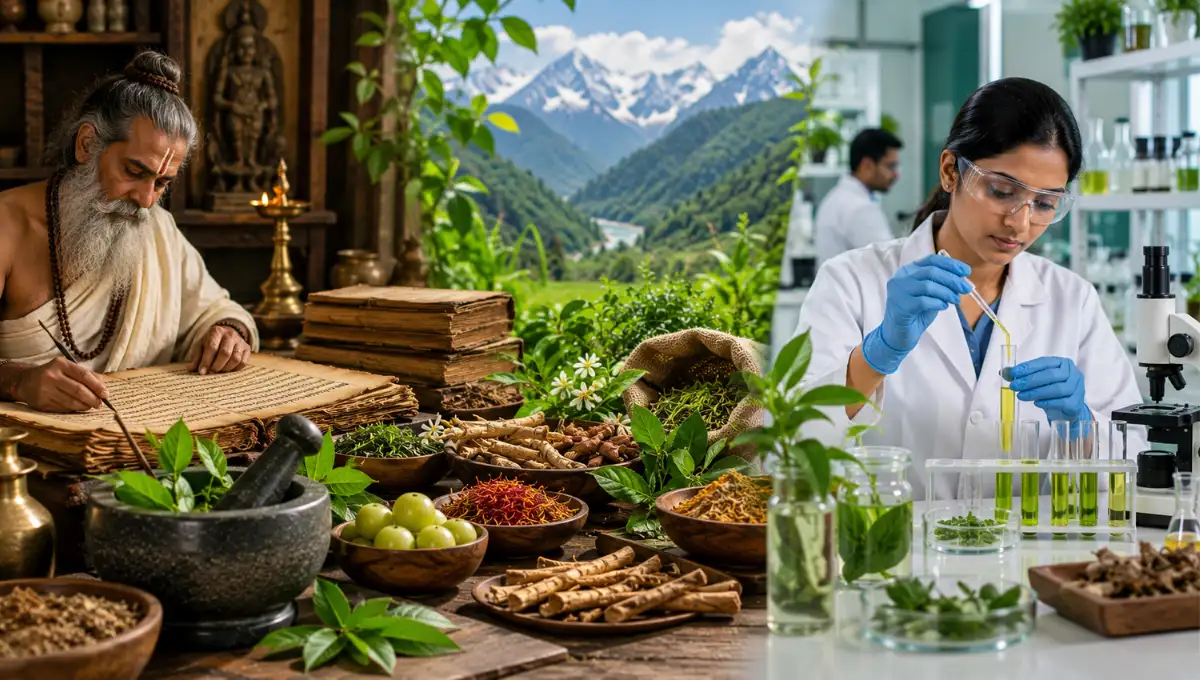
Ancient Texts to Modern Laboratories: The Journey of Natural Wellness Ingredients
A single herb mentioned in a centuries old text does not become a modern, research backed wellness ingredient overnight. It travels through a specific, multi stage research journey, one most buyers never see, but one that genuinely shapes how much confidence you can place in what ends up in a bottle on your own shelf.
Somewhere between a line in a centuries old medical text and a bottle on a modern shelf, an enormous amount of work happens, work most people never see or think about. This is not a simple, one step translation from old to new. It is a genuine, multi stage research journey, one with its own methods, challenges and honest limitations.
Understanding this journey also changes how you read a wellness product's claims. A brand describing an ingredient as "backed by traditional use and ongoing research" is making a claim about a specific position in a much longer process, not a finished, settled fact, and knowing what that process actually involves helps you interpret the claim more accurately.
This post traces that journey from beginning to end, so you can understand what "research backed" actually means for a traditional ingredient, and why some herbs have accumulated a genuinely substantial body of modern evidence while others remain in earlier, more preliminary stages.
Where the Journey Begins: Classical Texts and Oral Tradition
Traditional medicine knowledge exists in two primary forms, written classical texts and oral tradition passed down through generations of practitioners. Both represent genuine, accumulated observation, though they present very different challenges for modern researchers trying to access and interpret them, and both deserve to be taken seriously as starting points rather than treated as historical curiosities.
The Challenge of Working With Historical Texts
Classical medical texts, whether Ayurvedic, Chinese, or from other traditions, were written in specific historical languages, using terminology and conceptual frameworks that do not always translate directly into modern scientific vocabulary. A researcher working with these texts needs genuine expertise in both the historical language and the traditional medical framework itself, not simply a general translation, since a literal word for word rendering can easily miss the intended meaning entirely.
Oral Tradition Presents a Different Kind of Challenge
Knowledge passed down orally, common in many indigenous and folk healing traditions, is not written down at all, making it considerably more vulnerable to being lost entirely as older practitioners pass away without documentation. Ethnobotanical fieldwork specifically exists to capture this kind of knowledge before it disappears, often working directly with communities to record details that would otherwise never reach any written record at all.
The World Health Organization's Global Traditional Medicine Strategy for 2025 to 2034 recognizes traditional medicine systems as deeply embedded in culture and local practice worldwide, and specifically prioritizes documenting and safeguarding traditional knowledge as part of a broader effort to responsibly integrate it into modern health systems, treating this documentation work as a genuine research priority rather than a secondary, optional activity.
Ethnobotanical Documentation and Cataloguing
Once traditional knowledge is identified, whether in a text or through oral fieldwork, it needs to be systematically documented before it can become a genuine candidate for scientific study. This documentation stage is easy to overlook, but without it, nothing further along the journey can realistically happen.
What This Documentation Actually Involves
Ethnobotanists record specific plant identification, traditional preparation methods, dosage, and the specific conditions a remedy was traditionally used for, creating a structured record considerably more useful to later researchers than a vague, general reference to "this plant is used for wellness." This work often requires extended fieldwork, sometimes spanning years within a single community or region.
Why Precision Matters at This Stage
A poorly documented traditional use, one without a specific botanical identification or clear preparation method, is far less useful to later researchers than a precisely recorded one. This is part of why modern digitization projects cataloguing classical texts and ethnobotanical surveys represent such valuable, foundational research infrastructure, even though this groundwork rarely receives the same attention as the more visible clinical trials that follow much later.
Digitization as a Modern Accelerant
Ongoing efforts to digitize classical medical texts and make them searchable have meaningfully sped up parts of this documentation stage in recent years, allowing researchers to cross reference multiple historical sources far more efficiently than manual archival research previously allowed. This kind of infrastructure investment, while unglamorous, genuinely shapes how quickly a promising remedy can move toward the later stages of this journey.
Explore herbs studied through exactly this documented research tradition.
Shop ACTIZEET® Pure HerbsIdentifying Candidates for Laboratory Study
Not every documented traditional remedy becomes a subject of modern research. Researchers and funding bodies make specific choices about which candidates are worth pursuing, choices shaped by a mix of scientific promise and practical constraint.
Reverse Pharmacology as a Guiding Method
Reverse pharmacology, a research approach that starts with a traditional remedy already understood to work clinically and works backward to identify its mechanism, has become a particularly influential framework for selecting which traditional remedies deserve laboratory attention first, since the starting substance already carries a genuine history of safe human use behind it.
Practical Factors That Influence Selection
Beyond traditional evidence strength, practical factors genuinely influence which candidates get selected, how widely a remedy is already used, whether raw material is readily available for study, and whether funding exists to support the specific research needed. A genuinely promising remedy can sit unexamined for years simply because none of these practical conditions aligned at the right moment.
In Vitro and Preclinical Testing
Once a candidate is selected, laboratory research typically begins with in vitro testing, studying a compound's effects on cells or biological systems outside a living organism, before moving to animal studies. Both stages exist specifically to build a genuine evidence base before any human testing is considered appropriate.
Why This Stage Matters
In vitro and preclinical research helps identify a plausible mechanism of action and rules out obvious safety concerns before any human testing begins. This stage is genuinely necessary, but it is also where a considerable amount of otherwise promising traditional research currently sits, since moving beyond it requires substantially more funding and infrastructure than most preclinical research programs have access to.
The National Center for Complementary and Integrative Health notes that research on complementary health approaches, including many traditional remedies, often remains at an earlier preclinical stage, and specifically recommends that people consider the strength of available evidence rather than assuming preliminary laboratory findings translate directly into confirmed human benefit, a distinction genuinely worth keeping in mind when reading about any traditional ingredient.
Clinical Trials and Human Research
The most resource intensive stage of this journey involves testing a traditional remedy directly in human clinical trials, the type of evidence generally considered most directly relevant to real world use, and also the stage where the fewest traditional remedies ever actually arrive.
Why So Few Remedies Reach This Stage
Human clinical trials require substantial funding, ethical oversight, and often years of planning and execution. Many traditional remedies with genuinely promising preclinical results simply never receive the funding needed to move into this stage, a limitation of research economics rather than a reflection of the remedy's actual potential, and a genuinely important distinction worth remembering whenever you encounter a herb with limited clinical evidence.
Ashwagandha as an Example of a Remedy That Reached This Stage
Ashwagandha has moved further along this research journey than many other traditional herbs, with multiple randomized controlled trials now examining its effect on stress, anxiety and sleep specifically. This did not happen automatically. It reflects sustained research investment building on centuries of documented traditional use, a genuinely rare combination of traditional foundation and modern resourcing.
A health professional fact sheet from the National Institutes of Health Office of Dietary Supplements notes that ashwagandha has a long history of use in Ayurvedic medicine, and that a taskforce from the World Federation of Societies of Biological Psychiatry has provisionally recommended specific ashwagandha doses for generalized anxiety disorder, illustrating what it looks like when a traditional remedy successfully moves through the full research journey into genuine, actionable clinical application.
Publication and Peer Review
Research findings only become genuinely useful to the wider scientific community, and to product developers, once they are published in a peer reviewed journal, a process that adds its own layer of scrutiny and delay, but also considerable additional credibility.
Why Peer Review Matters
Peer review involves independent experts evaluating a study's methodology before publication, catching errors and weaknesses that might otherwise go unnoticed. This process genuinely strengthens the reliability of published findings, though it also means research can take considerable additional time to become publicly available, sometimes a year or more between a study's completion and its eventual publication.
The Visibility Problem for Non English Research
A meaningful share of traditional medicine research is published in regional, non English language journals, making it less visible to major international literature reviews that predominantly draw from English language, internationally indexed publications. This creates a genuine visibility gap between research that exists and research the wider world actually sees, one that likely means the true state of evidence for many traditional remedies is somewhat more advanced than commonly assumed.
Challenges Throughout This Journey
It would be misleading to present this entire journey as a smoothly functioning pipeline. Several genuine, well documented challenges affect it at nearly every stage.
Funding Bias Toward Patentable Compounds
Pharmaceutical research funding tends to favor patentable, synthesizable compounds over naturally occurring substances, creating a structural bias against fully investigating many traditional remedies to the same depth as synthetic drug candidates, regardless of how genuinely promising their traditional use history might actually be. This bias shapes which remedies advance and which remain permanently stalled at an early stage.
Standardization Across a Long, Multi Stage Process
Different research teams working on the same traditional remedy do not always use identical preparation methods or dosages, making it genuinely difficult to compare results across studies, an issue that compounds as a remedy moves through each successive research stage, from preclinical work through to eventual clinical trials.
Why This Journey Matters for Product Quality
Understanding this full research journey gives you a considerably more useful framework for evaluating a wellness product's claims than simply accepting or dismissing traditional use outright. A herb with documented classical use, ethnobotanical verification, preclinical research and at least some clinical evidence has traveled considerably further along this journey than one relying purely on traditional reputation alone, and this distinction is genuinely worth checking rather than assuming.
This is also why honest, specific representation of research strength matters so much in product descriptions. A brand that distinguishes clearly between a herb's traditional use, its preclinical evidence, and any available clinical research is reflecting the genuine, multi stage nature of this journey accurately, rather than collapsing it all into a single, undifferentiated claim that treats early preclinical findings as equivalent to confirmed clinical results.
ACTIZEET® is built around genuine respect for this full research journey, honoring the traditional foundation behind every herb we offer while representing current research strength honestly, wherever a specific ingredient happens to sit along this path. We would rather describe evidence accurately than borrow confidence from a herb further along its own journey.
Shop ACTIZEET® Pure Herbs →Frequently Asked Questions
A Journey Worth Understanding, Not Just Trusting
The path from a classical text to a modern, research backed wellness ingredient is genuinely long, involving documentation, candidate selection, preclinical study, clinical trials and peer reviewed publication, each stage adding real, checkable evidence along the way.
The next time you read a claim about a traditional ingredient being "research backed," it is worth asking specifically where that research actually sits along this journey. That single question separates a genuinely informed reading of the claim from simply taking it at face value.
ACTIZEET® is built around honoring this full journey, respecting the traditional foundation behind every herb while representing current research honestly, wherever that specific journey currently stands.