Ayurveda and Modern Science: Where Traditional Knowledge and Research Meet
Ayurveda is often described as either an ancient wisdom tradition or a set of unproven folk remedies, depending on who is talking. The more accurate, more interesting picture sits between these two extremes, a genuinely active area of modern scientific research building directly on centuries of documented traditional knowledge.
Few traditional medical systems have attracted as much sustained modern research interest as Ayurveda. Herbs like ashwagandha and turmeric now appear in peer reviewed clinical trials alongside their centuries old classical descriptions, and Indian research institutions have invested heavily in bridging traditional pharmacology with modern scientific method.
This relationship is easy to misunderstand from either direction. Some assume Ayurveda has already been fully validated simply because a few herbs have shown promising results. Others dismiss the entire system because certain claims remain unsupported by rigorous trials. The more accurate picture sits between these extremes, a genuine, ongoing collaboration where some claims hold up well under modern scrutiny and others remain honestly uncertain.
This post looks at how that bridge actually works, the specific research methods scientists use to study Ayurveda, what current evidence says about some of its most popular herbs, and the genuine challenges that remain before Ayurvedic claims can be considered fully validated by modern standards.
What This Convergence Actually Looks Like
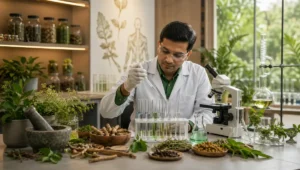
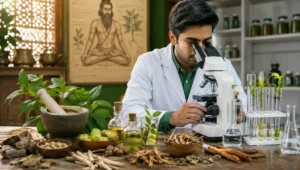
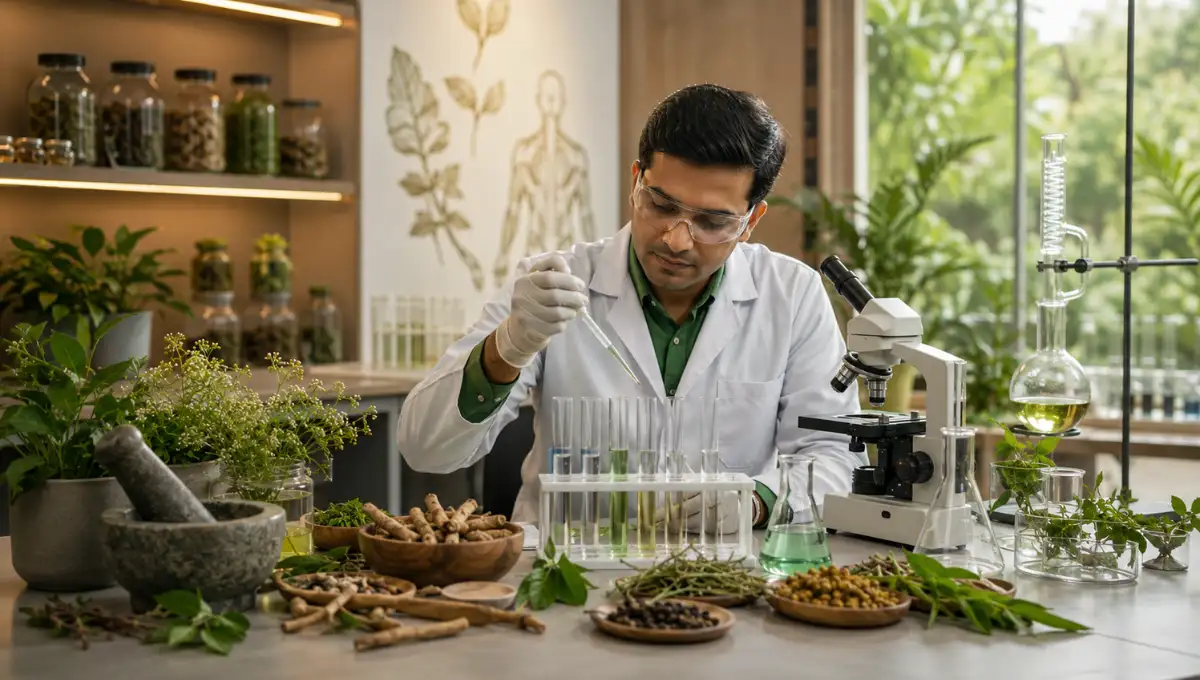
The relationship between Ayurveda and modern science is not a story of one replacing the other. It is a genuinely collaborative process, traditional use identifying a promising candidate, and modern research investigating that specific candidate using controlled, systematic methods. This pattern has repeated across pharmacology more broadly, and Ayurveda is one of the richest, most systematically documented traditions available for this kind of investigation, given its detailed textual record of specific herbs, preparations and dosing guidance stretching back centuries.
Not Simply Confirming Old Ideas
This process does not always confirm the traditional explanation exactly as originally understood. A herb might show a real, measurable effect that modern researchers eventually trace to a mechanism quite different from the one classical texts originally proposed. Both observations, the traditional one and the modern one, remain genuinely valuable even when they do not align perfectly, since the traditional system correctly identified a real effect long before the underlying biochemistry could be explained. Turmeric's traditional use for digestive comfort and skin health, for example, long predates any understanding of curcumin's specific anti-inflammatory pathways, yet the traditional observation and the modern mechanism both point toward the same genuine underlying effect.
The National Center for Complementary and Integrative Health notes that Ayurvedic medicine combines herbal compounds, diet, exercise and lifestyle practices, and while research remains limited compared to conventional medicine, some studies, including a 2013 trial comparing Ayurvedic treatment against a conventional drug for knee osteoarthritis, have shown promising comparable outcomes worth further investigation.
Reverse Pharmacology: Studying Ayurveda on Its Own Terms
Conventional drug discovery typically starts with a molecular target and searches for a compound that interacts with it. Ayurvedic research often works in the opposite direction, a method known as reverse pharmacology, which has become particularly associated with the scientific study of Ayurvedic herbs specifically.
Starting From What Already Works
Reverse pharmacology begins with a traditional remedy already understood to be reasonably safe and observed to work clinically, then works backward through laboratory and clinical investigation to identify the specific mechanism responsible. This approach carries a genuine practical advantage, since the starting substance already has a long history of human use behind it, addressing some of the early safety uncertainty that makes conventional drug development so slow and expensive.
Why This Approach Suits Ayurveda Particularly Well
Ayurveda's detailed classical texts provide an unusually rich starting point for this kind of research, specifying not just which herb to use, but the traditional preparation method, dosage and combination with other substances. This level of documented detail gives researchers considerably more to work with than a vague folk tradition passed down purely through oral memory, which is part of why Ayurvedic reverse pharmacology has become a genuinely active research area rather than a purely theoretical concept.
Explore herbs studied through exactly this research tradition.
Shop ACTIZEET®What Current Research Says About Popular Ayurvedic Herbs
Research volume and quality vary considerably by herb. Some have accumulated a genuinely substantial body of modern clinical evidence, while others remain in earlier, more preliminary stages of investigation.
Ashwagandha
Ashwagandha has become one of the most researched Ayurvedic herbs globally, particularly around stress, anxiety and sleep. Multiple randomized controlled trials and systematic reviews have examined its effect on cortisol levels and standardized anxiety scales, making it one of the clearer examples of an Ayurvedic herb moving from purely traditional use toward a genuinely substantial modern evidence base.
A health professional fact sheet from the National Institutes of Health Office of Dietary Supplements notes that research suggests ashwagandha extracts may help lower stress, anxiety and cortisol levels, and that a taskforce from the World Federation of Societies of Biological Psychiatry has provisionally recommended specific ashwagandha doses for generalized anxiety disorder, while cautioning that stronger recommendations require more extensive data.
Turmeric
Turmeric's curcumin content has been studied extensively for antioxidant and anti-inflammatory activity, though researchers continue working through a well documented bioavailability challenge, since curcumin absorbs poorly on its own, a limitation modern formulations increasingly address through pairing with black pepper extract or specialized delivery methods. Interestingly, this modern solution echoes a traditional Ayurvedic pairing of turmeric with black pepper that predates any understanding of the specific absorption mechanism involved.
Brahmi
Bacopa monnieri, known as Brahmi, has accumulated a meaningful body of research around cognitive performance and memory, with several trials reporting modest but measurable improvement in working memory and information processing speed over several weeks of consistent use, generally requiring sustained supplementation rather than producing an immediate, single dose effect.
Ayurgenomics: A Genuinely New Research Frontier
One of the more novel developments in this space investigates whether the constitutional categories described in classical Ayurveda, the three doshas, correlate with measurable genetic or biological markers, an emerging field sometimes referred to as Ayurgenomics. This research direction is notable precisely because it originates from a traditional conceptual framework rather than from a question modern science had already been asking independently.
Why This Research Direction Matters
This research is significant not because it has produced definitive answers yet, but because it represents traditional conceptual frameworks generating entirely new scientific questions, rather than simply being tested against categories modern science already assumed mattered. This remains an early stage field, and conclusions here should be treated as genuinely preliminary, but it illustrates a different, potentially valuable direction for this convergence beyond simply validating individual herbs one at a time. If constitutional categories like the doshas do eventually correlate with measurable biological markers, it could open an entirely new avenue for personalized approaches to wellness, grounded in a framework Ayurveda has used for centuries.
| Research Area | Current Evidence Strength |
|---|---|
| Ashwagandha for stress and sleep | Growing, multiple randomized controlled trials |
| Turmeric for inflammation | Substantial preclinical evidence, bioavailability remains a challenge |
| Brahmi for cognitive function | Moderate, several positive trials, more research needed |
| Ayurgenomics and dosha correlation | Early stage, genuinely preliminary |
The Real Challenges of Validating Ayurveda Scientifically
It would be misleading to present this convergence as uniformly successful. Genuine, well documented challenges exist, and being honest about them matters just as much as celebrating the genuine successes.
Multi Herb Formulations vs Single Variable Trials
Classical Ayurvedic formulations are frequently multi herb combinations, adjusted individually to a patient's constitution, which sits in real tension with the single variable design modern randomized trials generally require. Researchers have responded differently, some isolating single herbs like ashwagandha to fit conventional trial design, others developing new methodologies better suited to studying personalized, multi herb formulations without losing the individualized character central to classical practice.
Funding and Publication Bias
Pharmaceutical research funding tends to favor patentable, synthesizable compounds over naturally occurring substances, creating a structural bias against fully investigating many traditional remedies to the same depth as synthetic drug candidates. A meaningful share of Ayurvedic research is also published in regional journals, making it less visible to major international systematic reviews that predominantly draw from English language, internationally indexed publications.
The World Health Organization's Global Traditional Medicine Strategy for 2025 to 2034 recognizes Ayurveda and other traditional systems as deeply embedded in culture and local practice worldwide, and specifically prioritizes strengthening the research evidence base behind these systems as part of responsibly integrating them into national health systems.
Why This Matters When Choosing Ayurvedic Products
Understanding where Ayurveda and modern science genuinely meet, and where evidence still remains preliminary, gives you a considerably more useful framework for evaluating products than either dismissing traditional herbs outright or accepting every traditional claim uncritically. This balanced view also protects you from two opposite mistakes that are equally common in wellness marketing, either ignoring centuries of documented traditional use, or treating that traditional use as automatically equivalent to a modern clinical guarantee.
A wellness product genuinely rooted in traditional Ayurvedic use, and additionally supported by honest representation of current research strength, sits on far firmer ground than one relying purely on tradition alone or vague scientific sounding marketing language with nothing specific behind it. Look for brands that distinguish clearly between what is well established, what is promising but preliminary, and what remains genuinely uncertain, rather than presenting every claim with equal, unqualified confidence.
ACTIZEET® is built around exactly this balance, respecting the traditional Ayurvedic foundation behind every herb we offer while being honest about what current research does and does not yet confirm, backed by correct sourcing and batch specific quality testing across our full range.
Shop ACTIZEET® →Frequently Asked Questions
Two Traditions of Knowledge, Working Toward the Same Goal
Ayurveda and modern science are not competing explanations for the same questions. They are two different methods, one built on centuries of accumulated observation, the other built on controlled testing, increasingly working together through reverse pharmacology, clinical trials and emerging fields like Ayurgenomics.
The most useful takeaway is not to pick a side, but to bring a healthy, evidence aware curiosity to both. Take traditional Ayurvedic knowledge seriously as a starting point, expect real modern verification before drawing strong conclusions, and choose brands honest about where the evidence for their specific products actually stands.
ACTIZEET® is built around respecting both sides of this relationship, honoring traditional Ayurvedic knowledge while holding every product to honest, evidence based standards.